14 August 2017

Let Raleigh's Confederate monuments fall, too

Self-described white nationalists, carrying tiki torches and chanting, among other things, “blood and soil,” surrounded the statue of Thomas Jefferson on the University of Virginia’s campus and took to the streets of Charlottesville on August 11 and 12.  This particular slogan lays bare the leanings of many participants of the so-called “Unite the Right” rally; it was a Nazi slogan supporting the “purity” of Aryan blood and the virtues of working the land.  Today it is turned against African Americans and immigrants, especially Hispanic immigrants living here as undocumented residents.  Among the many emblems seen in crowd shots were swastikas and the Confederate battle flag, often flown alongside the Stars and Stripes.

The focal point of Saturday’s activity, which was declared an unlawful assembly by Charlottesville police as violence broke out, with a 20 year-old Ohio man injuring 19 and killing one as he plowed his car into a crowd, was a statue of Robert E. Lee, slated for removal from the city’s Emancipation Park.  Following, as it does, the politically-charged removal of monuments to the Confederacy and white supremacy in New Orleans, it’s hard to deny the symbolic power and comfort such monuments offer to modern-day white supremacists.

And why not?  The monuments were and are emblems of white supremacy, even when the words aren’t explicitly used, as they were in the removed Liberty Place monument in New Orleans, erected to commemorate a white supremacist uprising against the Reconstruction government there. 

All of the hubbub around these monuments suggest that maybe it would be a good time for us here in the Old North State to rethink our relationship to our Confederate monuments.  Citizens of Durham did this spontaneously on August 14, tearing down the monument dedicated “In the memory of the boys who wore the gray” that stood in front of the courthouse.  This is the only way to bring the monuments down at the moment; the General Assembly in 2015 passed a law requiring state permission for the removal of such monuments.  And so still, on Union Square, where our state Capitol building sits, there are four explicitly Confederate monuments.
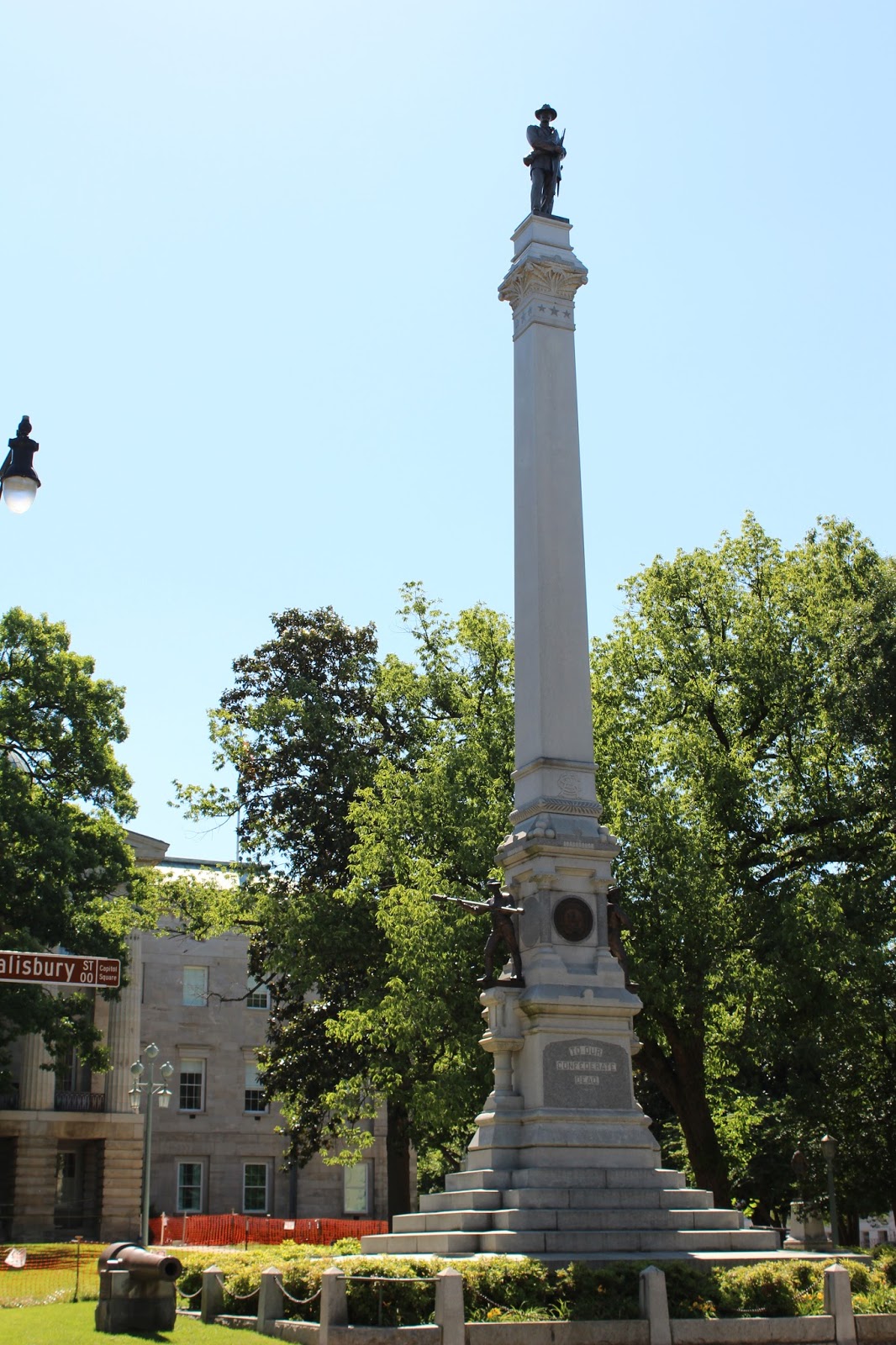
Pride of place goes to the 1895 Soldiers and Sailors monument that stands prominently at the end of Hillsborough Street, so that anyone approaching the Capitol is put face-to-face with it.  Dedicated “To our Confederate Dead,” it is emblazoned with the seal of the Confederate States of America, its 75 feet capped with a bronze statue of a Confederate soldier.  North Carolina gave more sons to the Confederate cause than any other states and this celebrates that legacy. 

Nowhere on Union Square is a monument to the 1,000 or so Tar Heels who gave their lives fighting for the Union, people who ultimately contributed to the liberation of the 4 million African Americans held as property in the sixteen states.

On the Morgan Street side is a monument to the Women of the Confederacy, gifted by a Confederate veteran and unveiled in 1914.  On the statue we see a Confederate matron, her face fixed in a mask of determination, steely gaze looking out.  Beside her a child, holding on to a sword, destined to be the next defender of Southern womanhood or some such.

Deeper in the Capitol grounds there is a monument to Henry Lawson Wyatt, the North Carolinan who was the first Confederate solider to die in the war.  A small thing to celebrate, I suppose, but the monument itself has a big name attached to it—Gutzon Borglum, who created the North Carolina monument at Gettysburg and the monument at Mount Rushmore.  Who knows why Wyatt fought?  Was he coerced?  Did he support slavery as an institution?  Whatever the case, he laid down his life that others might keep their fellow humans as animals.

Perhaps most insidious is the marker dedicated to Samuel A’Court Ashe, dedicated in 1940.  Ashe was the last surviving Confederate officer, and died in 1938.  His memorial lists his many accomplishments, and there are a few worthy ones.  He is eulogized as a “patriot, soldier, historian, legislator, editor, Christian citizen.”  However the first “accomplishment” listed is that he was “Captain and Assistant Adjutant General of Pender’s Staff.”  This “patriot” is being celebrated for his efforts on behalf of treason. 

It gets better.

The next line lionizes him as the “Heroic defender of Fort Wagner,” a reference to the Battle of  Fort Wagner in 1863, in which Union forces made a concerted effort to capture the strategic location, failing with heavy loss of life.  Among the fallen were members of the 54th Massachusetts, the unit featured in the movie Glory, a unit made up of African Americans.  So, for defending the white blood and soil of the Confederacy against African Americans, Samuel A’Court Ashe got a monument at the metaphorical heart of the state. 

What sort of message does that send to African American Tar Heels?

Here, then, is the crux of the matter.  These monuments, all of them, are intended to tell a story and educate the public.  The story here is that of the Lost Cause, the idea that the South fought to defend itself against the overreaching federal government.  That it lost only because it was overwhelmed by northern industrial might.  That the struggle to defend slavery was somehow noble.

They were intended to intimidate African Americans, and any who might work with them to build a better North Carolina, as well as to provide comfort to the white supremacist, a function they sadly still fulfill.  The year after the Soldiers and Sailors monument was dedicated, a Republican governor was elected and progress was possible under a multiracial coalition that controlled the entire state government. 

This progress was halted in the elections of 1898 by internal squabbling and a resurgent Democratic party campaigning on white supremacy, and its last vestiges were removed two days later by the Wilmington Insurrection, where whites threw out the Republican mayor and drove about 2,100 black citizens from the city, killing as many as 100, in a coup d’état.  A coup encouraged, it should be noted, by future governor Charles Aycock, also memorialized on the Capitol grounds.

They are, then, a statement that Black lives don’t matter.

Time to re-think our monuments indeed.  It’s hard to say these things in some ways.  I work in history, I have a preservationist impulse, though one that grows weaker all the time.  These monuments need to go.

Some cry “erasure” as these monuments fall.  But supporters ignore the act of historical erasure that they already represent.  For a long time, the dominant narrative of the Civil War was the “states’ rights” lie and the Lost Cause that went along with it.  That is what the monuments document.  What they are is a celebration of traitors who thought the defense of slavery a worthy act.  No just society celebrates injustice, and no sane society celebrates men who tried to destroy it.

Pull them down, Governor Cooper, Mayor McFarlane, members of the General Assembly.  Put the artistically significant ones in the North Carolina Museum of history with a full explanation (I’d love to see the damaged Durham statue in there…what an exhibit).  Grind the rest down and let African American artists make something worthwhile of them.  

When something bad happens, we so often shake our heads and say, “We’re better than this.”  Now’s a good time to put up or shut up.  Monuments are expressions of who we were and who we wanted to be when they were erected.  By leaving them in place, we leave the door open to being those people again, if we aren’t already.  

Let’s aspire to something better, and shout it to the world with something new.


02 June 2017

Trump Isn't Going Anywhere--Let's use the opportunity

Okay, fellow liberals, time to cut it out.  If I had a quarter for every time some smart person online has declared the imminent end of the Trump administration, I’d have enough cash to get my family out of this country until such time as it regains its senses.  Every day some revelation, some embarrassment, is heralded as the straw that will break the back of the man with the camel-colored hair.  But here’s the ugly truth—unless the man resigns, we’re stuck with him in the Oval Office until at least January 20, 2021.  This is an opportunity.

Forget about impeachment.  In order to impeach the President, 218 House members have to vote on articles, essentially indicting the President.  The trial is then conducted by the Senate, where 67 members have to agree on his removal. The House is currently split 239-193 (with 3 vacancies) in favor of Republicans; the Senate contains 52 Republicans and 48 Democrats (including two independents who caucus with Democrats).  So 25 GOP representatives and 19 GOP senators would have to cross lines.

On top of this is that the criteria for impeachment are vague.  The Constitution says the president can be removed upon conviction for “Treason, Bribery, or other High crimes and Misdemeanors.”  Those seem solid enough, and I’d bet all those quarters I earned in the first paragraph that Trump has taken more than one each from columns A, B and C.  But of course, the decision in this case of what bribery, treason, or high crimes and misdemeanors actually mean is left to the political class. 

Politicians are, of course, subject to public pressure, but given that only 13 out of 382 House incumbents were defeated in 2016, it seems safe to say that most Republicans won’t have a whole lot of impetus to turn on their own.  2018 isn’t looking much better. On top of the incumbency advantage in the House, there are only eight Republican Senate seats up for re-election, meaning that if Democrats held every one of their seats and swept Republican seats, they still end up eleven votes short of the 67 needed to convict, even assuming they do the unlikely and flip the House.

The so-called “25th Amendment option,” whereby the Vice President and Cabinet join to remove a president who is deemed incapacitated crashes on the same partisan shoals.  Republicans at this time seem unwilling to police themselves and since they control the government entire there are no watchers for the watchmen.  Unless Donald Trump is filmed wearing a hijab made of cat skins, fellating Vladimir Putin while kneeling on a Bible and urinating on an American flag, he’s not going anywhere.

Or, less likely, if he resigns, of course.

That’s the bad news—time for the good.

For decades, Republicans have been playing a very long political game.  They have captured 33 governorships, control both legislative houses in 26, and control the lower legislative House in 29 and the Senate in 29.  This has given them control of redistricting, which they have used for partisan purpose, though the results of this are debated.  It has also given them control of state voting regulations, which they have used to purge hundreds of thousands from voter rolls.

Democrats need to counteract this, and they need to do it fast—I am intentionally referring to Democrats here, since as long as we decide the highest election through the Electoral College, third parties are viable only as spoilers—to make up for the unfortunate fact that Democrats have focused on federal elections.  Control of state houses in 2018 and 2020 means control of redistricting after the 2020 census and a chance to roll back Republican-led voter suppression efforts. 

It won’t be easy.  The Republican message is easier to sell because it doesn’t ask anything directly of us.  Yes, the poor and the vulnerable will suffer under their policies, but what is sold is lower taxes, family values, standing up for the common man, patriotism, freedom.  They speak of rights without responsibility.  Playing to aggrieved whites fearful of losing unearned privilege they demonize racial, ethnic, and religious minorities.  That Republican policies, whenever they are enacted, restrict the freedoms of people who aren’t white, Christian, or male isn’t a bug, but a feature.  So, too, is the upward distribution of wealth that inevitable ensues, a theft then justified by the ideology that the wealthy are somehow more deserving than the rest of us.

We also have another opportunity.  In the wake of our withdrawal from the Paris Agreement on climate change, a remarkable alliance of governors and mayors has emerged to say that they will stick to their commitments under the agreement.  We need more groups like this that allow us to circumvent or mitigate some of the damage this administration is doing. Perhaps a shadow government as is often seen in parliamentary systems, where the opposition party appoints “cabinet secretaries” to counter the message coming from government, is called for.  We need mechanisms to hold media to account, so that following the folly of the moment doesn’t continue to obscure the larger stories.

Only by coming together to present a unified message and to counter the rank dishonesty coming from the administration, can we hope to break the Republican stranglehold at all levels of government and get the United States moving forward.  Trump has given us the challenge, and the opportunity.  It’s on us to take up both.


28 February 2017

Go back to school, Betsy Devos

I'd be shocked by the latest stupidity from Betsy Devos, but I suppose we shouldn't expect any better from an administration that appoints Jeff Sessions, who finds the Voting Rights Act "intrusive" and cheered its gutting in Shelby County vs. Holder, as a guardian of civil rights.

The Devos nomination was even worse in its way; Sessions is at least qualified on paper to hold his job. All Devos has done is run a charter school company that has done nothing to improve test scores in Detroit. But that's how it works...faith in the markets says that competition is good for schools and you KNOW how the school choice crowd feels about faith. I mean, let's face it, the magical market is their one true god, curing all ills, lifting all boats, and so on. And in the magical market everything is made better with choice.* Hey, those schools Devos' company ran in Detroit may suck, but at least parents could choose to send their kids to them. Who could have seen that an education company run by someone with no interest or experience in education might have been a catastrophe?

Given this I should have been prepared for the statement the Department of Education issued after Devos met with presidents of Historically Black Colleges and Universities (HBCUs). Instead of some anodyne statement about cooperation and progress, Devos (or whoever wrote the statement for her) used the opportunity to beat the drum of "choice." After evincing a desire to help communities that are undeserved, Devos speaks of the need for making "tangible, structural reforms that will allow students to reach their full potential," continuing, 

Historically Black Colleges and Universities (HBCUs) have done this since their founding. They started from the fact that there were too many students in America who did not have access to education. They saw that the system wasn't working, that there was an absence of opportunity, so they took it on themselves to provide the solution.

HBCUs are real pioneers when it comes to school choice. They are living proof that when more options are provided to students, they are afforded greater success and greater quality. Their success has shown that more options help students flourish. (emphasis added)


Look, I'm a teacher by trade. I teach history, and have taught it at some small colleges locally and now I am a full-time faculty member at an HBCU. I feel privileged to teach my students, and they certainly come here because they choose to come to an HBCU, a choice they make for as many reasons as they are students. And it's great that they have that choice.

But Devos is showing her ignorance here, or perhaps how captive she is to her idée fixe. Choice, remember, is the ultimate good.* Therefore any choice, no matter what circumstances, is good, irrespective of the historical circumstances that necessitated it and, given her company's track record, how good the outcome is. Again, we can relate this to those who see the market as the solution to everything, ignoring the weight individual participants bring and how that skews market forces.

Shaw University, where I teach, was founded in 1865. Think about that for a minute. It was founded in the immediate aftermath of the Civil War, its first students people who had only recently been enslaved and who wanted to make a better life for themselves, their families, and their communities. Yes, they chose to come here, but what other choices did they have if they wanted to attend college? St. Augustine's College opened on the other side of downtown in 1867. Fayetteville State College opened that same year, and other North Carolina HBCUs opened their doors in 1891, 1892. and 1909.

Which is great, right? Lots of choices for African American students! Except they couldn't attend the state's flagship institution, the University of North Carolina in Chapel Hill, until 1951. Or other, white schools. The choice extended to African American students, then, was limited. And it wasn't limited by market forces, or the inability of African American students to achieve, or by an inability to afford the cost, but by racism pure and simple. It was limited by an unwillingness on the part of the white power structure to treat African Americans as equal citizens and human beings. It was limited by Jim Crow, and Redemption, and the Ku Klux Klan. This is what Devos, perhaps inadvertently since she seems ignorant on so many things, is celebrating. 

Again, though, that shouldn't be surprising. As we ponder the possible outcomes of a Jeff Sessions as attorney general and see the outbreak of antisemitic and Islamophobic violence perpetrated by the racist fringe emboldened by the current political environment, why should we expect any better of Devos? 

Except we should be able to and that we can't is a real tragedy.

*Unless you're a woman who wants control over her own reproduction.


30 November 2016

Tyranny of the Minority: Graduating from the Electoral College

One was a former Senator and Secretary of State, even-tempered, highly-educated with a deep knowledge and appreciation of government, from a Presidential family.  Another fancied himself a tough guy, a voice for the common man, a self-made success who deserved to be President.  Bombastic, self-assured, and certainly racist.  On a December day, as the Constitution demands, electors met in their respective states to elect one the next president of the United States.

In 1824, John Quincy Adams, son of the second president, stood for office against Andrew Jackson, hero of the Battle of New Orleans, who had vaulted to national prominence from the backwoods of Tennessee (or maybe North Carolina).

When the popular vote was tallied, Jackson led Adams by about 40,000 votes out of 264,000 cast for the two.  In the Electoral College, Jackson again led Adams 99 to 84, well short of the 131 needed to win, meaning the House of Representatives would settle it, and the House elected Adams to his lone term.

Jackson, for his part, knew how to hold a grudge.  His supporters worked to bring more voters into the system and, in 1828, he would decisively beat Adams.  But four more times—in 1876, 1888, 2000, and now in 2016—the Electoral College would select the candidate with fewer popular votes. 

Arguments for the Electoral College are well-worn by this time: it assures that the smaller, less populous states get attention; it prevents democratic mob rule; electoral vote totals amplify the perceived mandate for the winner, making governance easier.

Only the second of these, fear of democracy, really seems to have mattered.  In Federalist 68, Alexander Hamilton argued that the selection of the President by Electors was better than allowing Congress or the people, democratically, to elect the executive.

“A small number of persons,” Hamilton wrote, “selected by their fellow citizens from the general mass, will be most likely to possess the information and discernment requisite to such complicated investigations.” 

The job could not be entrusted to the people, but to their betters who, being possessed of more knowledge and a broader outlook would make a wiser choice, while still reflecting, as Hamilton put it, “the sense of the people.”

James Madison was quite clear that democracy would favor the voter-rich northern states against the southern states with their large number of enslaved people and non-voting whites when in the Constitutional Convention he noted that “the right of suffrage was more diffusive in the Northern than the Southern states; and the latter could have no influence in the election on the score of the Negroes.”  The Electoral College was a suitable compromise for slaveholding states. 

However, what the method of election chiefly did was allow the southern states to enjoy the disproportionate influence accorded them by their vast enslaved populations who, though they had no voice in government, counted towards the numbers of representatives and electors, albeit at the discount exacted by the Three-fifths Compromise.


Even in the early elections, before the admission of more slave states and a skyrocketing enslaved population, the advantage was perfectly clear.  Virginia had by far the most electoral votes in the 1792, presidential election, almost half again as many as Pennsylvania and Massachusetts, though by free white population it should have been roughly equal to Pennsylvania, and one ahead of Massachusetts.  Combined, the Southern states had electoral clout based on their enslaved populations alone that more than outweighed Pennsylvania’s slate of electors. Small wonder, then, that seven of the first ten presidents were from, or at least born in, Virginia.

That the Electoral College is undemocratic should be no surprise; it was designed to be so.  Its real weakness, though, is that it has been, at least since the 1820s, a failure in its stated purpose.  Even when it has overturned the will of the voters, as it now appears poised to do yet again, it has done so on behalf of another group of voters and under the control of political parties. 

Today we have a different sort of imbalance.  Because each state has a minimum number of electors, regardless of population, a group of low-population states can balance, even overwhelm, the votes of states with much higher population.

Typically, of course, the Electoral College simply follows the popular vote, though with wider margins.  It doesn’t usually radically overturn the will of the voters—even the 3% margin Rutherford B. Hayes overcame in 1876 produced the difference of a single electoral vote.  Far from making decisions removed from the whims of the people, it has endorsed them at almost every turn.

Since it has in the main been an undemocratic institution functioning sort-of democratically, why not just get rid of it?

Simply because when it malfunctions, it does so in one direction.  Not necessarily, even if practically, in a partisan direction, but in the favor of the citizens of rural states, giving those states an outsized say in elections.  They have, then, no incentive to change and there are enough of these states to prevent a Constitutional amendment eliminating it.

Arguments about attention, mob rule, and perceived unity are a fig leaf to cover this fact, that as long as the Electoral College remains, such states will be a firewall for conservatives in close elections like this one. 

It is time, therefore, to recognize the Electoral College for what it is …a mechanism for allowing a minority of voters to thwart the will of a majority or plurality, an instrument for the naked exercise of power.

And we already have the Senate for that. 

17 September 2016

W.P. Kinsella- An Appreciation

I did not read all of the works of William Patrick (W.P.) Kinsella, the Canadian author who took his own life by assisted suicide at the age of 81 on September 16.  In fact, except for the occasional re-reading of one of several short stories, I hadn’t read anything from him since 1996’s If Wishes Were Horses.  Following the release of that novel, Kinsella was injured by a van while walking, and for the rest of his life found the concentration, and the desire, necessary for his writing hard to come by.  After 1997, he would not release another novel—though he continued to publish short stories—until 2011.

Like most of Kinsella’s American audience, I came to his works through the 1989 movie Field of Dreams, based on Kinsella’s novel Shoeless Joe, itself an extension of his earlier short story “Shoeless Joe Jackson Comes to Iowa.”  I remember seeing the movie when I was 18 and being struck by the power of the storytelling.  References to old ballplayers were fine trivia points, even when the screenplay got details wrong, and added meat to the story. 

This led to the book…and then to others he had written.  Then I was primarily reading his baseball stories.  Baseball is a sort of American mythology.  James Earl Jones’ character is right when he tells Ray Kinsella that America has grown up with it; it was born, or at least came into its own, in our rebirth after the Civil War. 

Kinsella, a Canadian, didn’t have much to say about America, except indirectly, but he was the bard of baseball’s mythology.  Having earned his MFA at the University of Iowa, he had at least a passing acquaintance with the American “heartland,” and a feel for the rhythms of small town life that served him well in his writing.  For Kinsella the baseball diamond was the world rendered in miniature, encompassing its possibilities.  The two were tethered, indeed in several of Kinsella’s stories characters are seen to observe that, in theory, baseball diamonds extend to infinity, so all the world is contained in them.

Because of this anything that could happen, that might even be remotely possible, did happen.  A left field created out of an Iowa cornfield could summon the shade of “Shoeless” Joe Jackson.  Armageddon could logically hinge on one pitch, in which the Chicago Cubs either win or lose the National League pennant.  The New York Giants of the 1950s could be a collection of top-notch ballplayers and autodidacts, speaking an average of three languages each, allowing a fourteen-year-old stand-in for the author with an unerring eye to pinch hit. A cabal of devoted baseball fans, waiting for the end of the 1981 strike could, one square foot at a time, replace the artificial in Kansas City’s stadium. 

He wrote of games that went on for thousands of innings, in which gods and various otherwise inanimate objects joined; of twins who played catch in the womb, one destined to be a pitcher and the other a catcher; of baseball dreamers and schemers.  Sometimes baseball was the focus, sometimes it was the backdrop.  In his stories it provided order, and occasional tragedy, to the lives of characters, to the cosmos itself.    

In another cycle of stories he wrote about the lives of Cree Indians on a reservation in Alberta.  These spoke to me less, but they were warm and humorous even in tragedy.  And in them, baseball was never far off.  I know he was criticized for appropriation—something Kinsella derided as a creation of East Coast academics—of First Nations’ voices, but I can’t help enjoying them for their humanity, and the respect with which he treated their lives.

Kinsella, at the end, had suffered a long time from diabetes.  Most of his last years were apparently spent playing on-line Scrabble, having apparently been an avid tournament player.  Due to complications he sought, and received, medical assistance in ending his life.  This year has been one noted for its deaths of public figures.  I’m not surprised by it, and expect next year to be busier; a generation of stars, many hard-living, who were idols to children of the 1960s and 1970s is getting long in the tooth, and the actuarial projections must be grim. 


W.P. Kinsella wasn’t one of those, but his is another loss in a year of them.  Stories about baseball aren’t everyone’s cup of tea, and I can imagine many people walking away from one of his works wondering what the fuss is about.  But his style is hard to deny.  He wrote touching and often funny stories about mostly real people, usually facing weird situations on or near a baseball diamond (of course, everything that happens happens on a baseball diamond, if you remember).  He increased my appreciation for baseball.  I think of something from one of his stories almost every time I come near the game, and it usually makes me smile.  A tremendous gift, that, and one that leaves the world a little poorer for its loss.

14 September 2016

On immigrants, undocumented and otherwise

Immigration, it seems fair to say, has been at the top of our national political agenda for the last several years.  And with the ascendancy of Donald Trump to the republican nomination, it seems to be on everyone’s mind.  There’s no need to re-cap his position, whichever iteration of it he’s on.  I’ve written before about bits of it, especially concerning Muslims, as his proposals have intersected with my own interests.

Since it’s so much talked about, everyone, it seems, has an opinion, especially on what to do about undocumented immigrants.  These are, as everyone knows, people who have entered the country illegally or who have entered the country legally but overstayed their visas.  When I was a child we called them “illegal aliens,” which I think we can agree is less friendly and not just because it spawned a dopey Genesis song.

In some quarters, undocumented immigrants are called “illegal immigrants” or even the worst of all, simply “illegals.”  That term offends because it completely de-personalizes and dehumanizes, which I suppose is the point.  I guess if we don’t have to think of them has humans then we don’t have to treat them as humans.  Almost equally offensive is the term “anchor baby,” applied to children of “illegals” born in the United States and thus automatically citizens.  For now. 

None of this is new.  What is new is a suggestion that I recently saw which has made me re-think the whole issue of “undocumented immigrants” altogether.  In a discussion thread, one of the participants made the following argument:
  1. Immigration is a legal process
  2. So-called “undocumented immigrants” are here illegally and not in that process.\
  3. Therefore, so-called “undocumented immigrants” aren’t immigrants at all.
QED, amirite?

At first sniff, this argument stunk, never mind that no alternative nomenclature was on offer. Always wanting to learn new things, I consulted some dictionaries on immigrant and immigration, looking at primary definitions. 
  • Immigration: the act of coming to live permanently in a foreign country.
  • Immigrant: a person who comes to live permanently in another country

Then, since the definition of immigration refers to immigrating.
  • Immigrate: come to live permanently in a foreign country

Yes, the word immigration does contain a reference to authorization, but the semicolon suggests a separation.  Yet neither immigrant nor immigrate makes any such distinction.  The definition for immigrant, for instance, does not read “a person who legally settles as a permanent resident in a foreign country.”  No, after second and third sniffs this argument continued to stink.

Besides the lexical problems, others arose, these more personal.  My mother’s side of the family came to America in the early- to mid-seventeenth century; my father’s in the 1790s.  Ignoring my maternal ancestors who, whatever they were doing, were moving from England to, well, England, we need to consider the paternal line, moving from England to the United States of America.  In the 1790s there were no immigration controls.  Therefore, there was no legal process.  By the argument above, then, no immigration means those Bazemores were not immigrants.  Then what the hell were they?  Settlers?  No, the place they came to, northeastern North Carolina, was already settled.  Clearly there was immigration; there were tons of people migrating in (see what I did there?) to the United States.

They were, not to put too fine a point on it, immigrants.  Etymology is our friend in this.  All of the words under discussion emerged from the Latin verb immigrare, literally “to move into.”  The denotation of the words is pretty clear.  Of course, anyone who studies language knows that usages change faster than dictionary definition, but usage is our friend, too.  By its existence, the term “undocumented immigrant” tells us that, yes, anyone who comes to the country and intends to stay is an immigrant.  The only reason there is any delineation is because we now attempt to control immigration through law.

In fact, what separates an immigrant from any other visitor to the country is that the immigrant is not a visitor at all.  He or she has come to live permanently in this country.  At that point the immigrant, undocumented or not, ceases to be an immigrant—the process of immigration is over.  That person is a resident.


Which is the whole point of the last 700 or so words.  The human beings referred to in this argument are residents of the United States of America.  And if we’re going to be honest in our writing and speaking perhaps we should recognize that fact (though to do so is certainly politically inconvenient).  Why don’t we try “undocumented residents?”  Maybe that will put a different gloss on the matter.

29 August 2016

Colin Kaepernick and the American Civil Religion

If this were fifteen years ago, one might bemoan the trees that had died to publish the multitude of opinions on the Colin Kaepernick affair.  Fortunately this is the age of the Internet, and though I’m sure the electricity that has powered the debates has some non-zero effect on global warming, the habitat loss and deforestation is at least mitigated by the fact that those debates are mostly taking place in the virtual world.  For those who have been living under a rock, the short version is this: on August 26th, prior to a pre-season game, San Francisco 49ers quarterback Colin Kaepernick refused to stand for the Star-Spangled Banner. 

Response was immediate and, as you might predict, ran from  outrage to praise.  Kaepernick’s explanation, that he sat because he had no wish to “stand up and show pride in a flag for a country that oppresses black people and people of color,” has struck all the nerves you would expect in a polarized political environment where the simple statement that Black Lives Matter has to be followed up with All Lives Matter, Blue Lives Matter and, in the newly-ascendant alt-right, White Lives Matter. 

Though most ordinary people seem to think he should have stood up, some have used the opportunity to point out the racist lines in the third stanza of the song (did you KNOW there was one?), which lends a little scholarly gravitas to Kaepernick’s argument, though there is as yet no indication whether he knew this when he made his gesture.

I’m not about to opine on this situation, any more than to say that I personally find most rituals a bit silly.  Who cares if Colin Kaepernick doesn’t want to stand for (or Gabby Douglas forgets to put her hand over her heart during) the national anthem?

Plenty of people it turns out.

Kaepernick (we will mostly leave Douglas out, as she has claimed her actions were accidental and there is no reason not to believe her) has performed a social sin of the highest order—he has declined to participate in a key ritual of our civil religion.  American Civil Religion, as I have written earlier concerning a controversy over the Pledge of Allegiance, is a set of references and symbols, often referring to a non-specific God, that are intended to recall us to a higher purpose for the nation.  Routine references to the Almighty in the Pledge, in the motto “In God We Trust,” in the invocation of “God bless America” in every political speech are related to this.

Indeed, the American Civil Religion is so prevalent, that I have come to suspect it is the chief sect of most Americans, superseding the cult many participate in on various Sabbaths. 

There are many rituals in the American Civil Religion, and one of the most common is the complex of rites surrounding the display of the American flag before public spectacles, especially sporting events.  Having the flag brought in by color guards, the march to the center of the field, the singing of the “Star-Spangled Banner” are acts of worship (unkindly, we might call them idolatry).  Through them, spectators are momentarily bound—the word “religion” probably originates in the Latin religare, “to bind”—to one another, members of one family.

When Colin Kaepernick declines to stand for the national anthem, he is declining to participate in the American Civil Religion.

Of course in America this shouldn’t be a problem.  The First Amendment to the Constitution secures for us all the right to participate (or not) in religious services, to speak (or not) as we choose.  But the real challenge Kaepernick presents is not one that is always amenable to logic.  Even in a relatively secular country like the United States religiosity, signaling religious belief, carries a great deal of importance.  

For reasons stretching deep into prehistory, religious display has evolved as a proxy marker for trustworthiness.  Religious people, speaking generally, trust other religious people, a phenomenon that it has been suggested is responsible for widespread distrust of atheists.  Since religiosity is a way of signaling, “Hey, you don’t know me, but you can trust me,” people who do not show religiosity are unconsciously signaling that they are not to be trusted.

This distrust is exactly why the responses to Kaepernick unfold as they do.  A small number of people, who have eschewed much display of faith in the American Civil Religion, don’t see the problem.  For larger numbers of people, who consider themselves patriots, who love the flag and all that they think it stands for, Kaepernick’s refusal to stand is nothing more than a wholesale rejection of their faith.  That’s why even a potentially accidental transgression like Douglas’ garners so much attention.  Because, even though religion is a proxy marker for trustworthiness, reminders of secular authority can mitigate the distrust of the non-religious.  Secular authority subsumes sectarian identity in the public sphere.

And the American Civil Religion is one of those “secular” authorities, one that is supposed to be the same for all Americans (though it, too, sometimes fails the non-religious).  What happens when Americans decline to participate in it?  

Watch the fallout from Colin Kaepernick’s actions to find out.


17 May 2016

Religion By Other Means: Politics and Ultimate Meaning

During this year’s odd primary cycle I have been moved many times to refer to the “movement” that has accreted around Vermont senator Bernie Sanders as something of a “cult.”  When I have made this criticism, it has usually stemmed from the vitriol of Sen. Sanders’ supporters whenever any criticism is launched at him.  This has been especially true when he has engaged in the naked sort of politicking that he and his supporters have criticized rival Hillary Clinton for.  Whenever the foibles of the leader are pointed out, supporters can be counted on to reply that it’s different for Bernie, that when he does the things that other politicians do, he’s not really doing the things that other politicians do.  Such rationalization seems like the adoration cult followers give to their leaders, who are so self-evidently right that, when we see them doing wrong, the fault is not in them but ourselves.

Yet the more I thought about it, the less surprised I was, because I am increasingly convinced that politics, at least in the United States, is simply religion by other means.  I think it may be argued that every political movement in the United States and Western Europe is a Christian heresy of sorts, a point I am not prepared to press here.  But I am prepared to offer a provisional argument on the issue of politics as religion, and to offer some preliminary thoughts of the place of groups like those supporting Sanders in it.

It is a truism on the left that religion and politics should forever be separate, just as it is a truism on the right that they should not.  On the left (and it is here that I place myself) the argument is that religion should have no part in the governance of a pluralistic nation and that secularism, government neutrality on issues of religion, should be the rule.  The right argues that we have become too secular, that we have fallen away from our religious underpinnings and that only by returning to them can we, to steal a phrase, make America great again.

I think both of these miss the point.

I’d like to suggest that, for many people, politics is religion.  This is not to argue that it has supplanted, for instance, the Christianity that so many Americans profess.  Rather, one runs alongside the other.  On the left, the tracks are skewed apart; on the right, they move towards an intersection. 

Most Americans are members, to varying degrees of both sects.  Such a situation is not unprecedented—it was faced by Rome as it expanded throughout the Mediterranean world and incorporated diverse peoples. Conquered people saw their pantheons assimilated to the Roman pantheon, becoming part of the larger Roman civil religion.  At the top was the imperial cult, centered on the living god in Rome and his divine predecessors.  As long as one did not commit the sin of atheism, the denial of any god, one could get along fairly well, and in day-to-day life follow the practices of their forebears (this was a positive thing; abandoning the religion of one’s forefathers was an act of impiety).*

Compare this to the civil religion of the United States.  Its gods are the Founding Fathers, agents of a supreme but ultimately unknowable and generic God, who bestows blessings on this country as long as we acknowledge divine providence in some non-specific fashion.  Its rituals are the Pledge of Allegiance, the national anthem at sporting events, and the ritual invocation of God at the end of every political speech.  America’s God is so non-specific that the gods of immigrants can be assimilated to it, much as the Roman pantheon absorbed the pantheons of conquered people.

Politics is the church of the American civil religion, and politicians are the clergy of it.  I don’t simply mean this metaphorically.  Since the eighteenth century we have increasingly used government to answer the sorts of questions traditionally answered by religion.  Not questions about the origin of the world or our place in the cosmos, but the questions of how our society should function and how we ought to relate to one another.   These are, in their way, questions of ultimate meaning, as they define the world we will live in.  Political language is the language we use to pose and answer these questions.  Founding documents, especially the Constitution, and the writings of the founding generation are its sacred texts, the texts we resort to and quote (or misquote) to make a particular point.

Our own political church has two main denominations, Democratic and Republican.  Like different Christian denominations there is a core dogma: professed belief in republicanism, some adherence to the notion of American exceptionalism, reverence for the Founding Fathers.  There are also differences, mostly centering around the interpretation of the sacred texts and the amount of lay participation that should be permissible.  Small wonder, then, that political fights can be so vitriolic; we are dealing with fundamental matters.  Each denomination views itself as the guardian of an unchanging orthodoxy that continues on in the tradition of the Republic’s founders, and denounces the other as heterodox.

Yet each major denomination is large enough that the other’s denunciations are largely irrelevant, just as a Catholic accusation of heterodoxy against, say, the Baptists would be.  Each can continue to compete for the votes of the laity, with elections deciding the result.  However, there are minority factions within each party for whom the charge of heresy bears some weight and the major denominations are left with the quandary of what to do with them.  In the tried and true fashion of Christianity, the parties generally try to co-opt their heretics, taking the best ideas and pushing those who will not be reconciled farther and farther to the margins.

This is where the libertarian wing of the Republican party was four years ago, before it morphed into the Tea Party movement and threatens to foment another schism in American politics through the nomination of Donald Trump.  It is also where the Bernie Sanders movement, if it can yet be called that, is now.  Guardians of Republican orthodoxy fought the Tea Party until they needed it.  Something similar might happen to the Democrats.

It’s not an accident, I think, that these two movements are so readily paired.  Both are characterized by their receptivity to a message of economic grievance, to a sense that the elites have sold them out and left them behind.  We might in this see the cry of late medieval parishioners who felt their soteriological needs were not met by absentee or illiterate clergy.  Grievance is surely the seedbed of revolutions.

Trump’s challenge to the Republican orthodoxy is the challenge that truly threatens a schism.  It is analogous to the Arian controversy that threatened to destroy attempts at Christian unity in the fourth century.  Paul Ryan, representing the orthodox party, has met with Trump in an attempt to restore unity.  How that ends we’ll have to wait to see.

Sanders’ challenge is different.  Drawing from a great many independents, it seems unlikely that he will create a schism among Democrats.  Going back to questions about cults earlier, I think that Sanders and his supporters are political Gnostics.  Gnosticism is a term used to describe a variety of ancient religious systems that emphasized a strict duality consisting of the material world and the spiritual world.  Christian Gnostics argued that an evil god, referred to as the Demiurge, created the world and the spiritual Jesus came to redeem it.  By embracing the secret knowledge of Jesus, adherents could escape the clutches of the Demiurge and be redeemed.

It’s hard not to see this in parts of the Sanders movement.  Those of us who find ourselves at odds with it are told that we must not clearly understand Bernie, for to understand is to believe.  And belief, we are told, will free us all as more and more people learn the truth.  Nebulous “elites” and “one percenters” are the forces of the Demiurge working in concert to keep our divine sparks shackled to the world of toil.  The DNC represents the party orthodoxy, interested in maintaining its monopoly on “truth” to keep itself in power. 

One can see vestiges of this in Trump supporters as well, which should be no surprise since the Tea Party emerged from another Gnostic sect, this one comprising Republican libertarians.  Like some latter-day Augustine, I can speak personally of this.  My time as a libertarian showed me many who again saw themselves as possessed of a special knowledge that would liberate the world, fighting the Demiurge (the Federal Reserve, the United Nations…take your pick) that sought to drag us all back in the muck.  If only, we were convinced, people would take the time to listen and think, they would come around.  It by no means characterized all libertarians, any more than it characterizes all Sanders supporters, but it was a prevalent strain in my interactions.

None of which should, by this point, be surprising.  If we are to take seriously the notions of politics as religion by other means, we should expect nothing less.  The battle is not over votes or over power, the players seem assured, but over the soul of America itself.


 *Christianity in the Roman world ran into trouble because it refused to play along, committing all three cardinal sins: it refused to participate in the imperial cult, it denied the gods of others and, at least in early generations, Christians abandoned the faith of their forefathers as they converted.  

20 February 2016

Artifacts of Memory, Memories of Artifacts

When I held the key to the Bastille in my hand, testing its cold heft, I could imagine the clank of the massive lock closing.  Another person, having held the object, had opined that the lock opened by this key would have been easily picked, but that seemed hardly a weakness.  Who would have worried about break-ins at the heavily-guarded medieval fortress in the heart of Paris?  Breakouts would have been the more logical concern, though by the time the fortress fell there were only seven prisoners.  When the vainqueurs, officially numbering 954, decided to effect an entrance, the lock was surely an afterthought.  Once the edifice was in flames the key, now useless, was gifted to George Washington by the Marquis de Lafayette, a present from French revolutionaries to the Americans who had inspired them.

But of course, this wasn’t the key to the Bastille.  Ridiculous to think that such a priceless artifact would accompany the representative of Mount Vernon to this teaching seminar in Raleigh.  This key was a cast iron replica of the original which at that moment rested on display at Washington’s home, an object that is apparently one of three original objects that has remained at the house over the centuries.  Whatever emotional associations I made with the key I held in my hand were mine, it would seem, since unlike the original it had never passed through Lafayette’s hands to Washington’s (with Thomas Paine serving as an intermediary on one leg of the trip).

Holding this object brought to mind a scene from the Philip K. Dick novel The Man in the High Castle, as well as in the superb Amazon.com television series based on it.  In the scene, which takes place in an alternative world where the Axis powers triumphed in the Second World War, an antiquities dealer discusses what makes a certain object more valuable than some other, identical, object.  He displays two cigarette lighters, one of which had rested in the pocket of Franklin Delano Roosevelt when he was assassinated (the turning point in this world’s history) and another lighter, in all respects the same, except that it had no association with FDR.

What makes the one an object that his customers would pay thousands of yen for and the other a mere trinket?

Historicity, we are told.  That Roosevelt had held the locket, that it had been in his pocket as he died, imbued it with some essence lacking in other lighters.  In the show the antiquities dealer tells us this is all balderdash but that his Japanese clients believe in it is enough for him, and allows him to make his living. 

By extension, we can see that this applies to all sellers of memorabilia.  The baseball, or jersey, or signed photograph or autographed first edition itself isn’t the draw…it’s the personal connection to a sports hero, or movie star, or author.  Touching these objects, collectors seem to believe, will allow some of the power of the famous person to come through, much as some cannibals believe they can gain the power of a vanquished foe or the wisdom of a revered elder by eating their remains. 

Of course, like my impressions of the storming of the Bastille, this entire process occurs in our minds.  There are countless millions for whom hefting the replica of that famous key would have been nothing more than a physical appraisal of the object; the thing itself need be no more valuable than the iron it was made of.  My momentary reverie only occurred because I know the story of the Bastille, and I knew that this key was a replica of the other, more famous one.  So why bother?

Because I lied earlier—that object I held is really, literally, the key to the Bastille.  Though it was probably cast within the last couple of decades, it is just as real and just as much the key to the Bastille as the original displayed in Washington’s home.  How is this possible?  Staying in the present, this key was made using the original as a model.  It is made, inasmuch as it is possible, of the same material.  It looks the same, it feels the same (or so I assume), it probably tastes the same, has the same weight, harmonics, etc.  Were I to sneak into Mount Vernon in the dead of night, and switch the two keys, no one would likely be the wiser. 

If I destroyed the original I had stolen, who would know... or even care to?  Allowing the secret to die with me, the world would go on believing that the key in the display case had been touched by some anonymous vainqueur, Lafayette, Paine, and Washington.  The key I placed in the display cabinet would, to all intents and purposes, be the original. 

I also held the key to the Bastille in another, more direct sense.  Having this replica, and the ability to travel back in time, I should be able to unlock the famous prison.  Again, the circumstances of its production are irrelevant; if it would unlock the nefarious lock, it is the real key, historicity be damned.  And that’s a damned peculiar thought, one sobering to a historian, or anyone concerned with grasping reality, whatever that is.

04 December 2015

Watch Lists and Gun Control- A Letter to My Fellow Liberals

Hi fellow liberals.  It’s me, Mike.  Can we talk for a minute?  Now you know I love each and every one of you—although  the “nominate #Bernie or I’m gonna take my bat and ball and go home” crowd really tests me—and I think I’ve been a staunch advocate for gun control, but we’re going just a little bit crazy.  There’s a lot of complaining about the defeat of a bill that would have prevented people on the terrorism watch list from buying guns.  What’s not to love, right?  They’re on a TERRORISM WATCH LIST for crying out loud! 

Here’s the problem.  Those people have not been convicted, or even charged, with any crime.  At all.  That’s a real problem.  Our Constitution, for good or ill, prevents the government from stripping away rights without due process.  And, yes, buying a gun is a right.  Sure, we could have a big argument about the militia clause in the Second amendment.  Sources on the ratification debate sure look like the framers of the amendment envisioned militia service in conjunction with the right to keep and bear arms (hunting also comes up…protection against one’s own government does not).  This dovetails nicely with the general fear of standing armies, which citizen militias were supposed to make redundant.

But let me clue you in on a dirty little secret, one the right has known for years: the Constitution means precisely what five justices say it means.  No more, no less.  There is no Platonic form of the Constitution, no absolute meaning waiting to be discovered.  Since the justices have determined that the right to keep and bear arms is an individual right, it is.  Even stranger, their decision means it’s been there all along.  Until another set of justices decides differently.

Which is the long way around saying that any action to control access to firearms has to contend with the civil right in the Constitution.  As long as gun buying is a right, then, it cannot be arbitrarily taken away.  For instance, by some bureaucrat adding your name to a watch list.  And passing a law?  I would guess that any such law would run afoul on the prohibition on bills of attainder right there in the Constitution (Article One, Section Nine, Paragraph 3).

Now I don’t for a moment think that the GOP voted against the bill for any reason other than that it’s in the pocket of the NRA.  Or perhaps as a simple negative reaction to Democratic proposals. But it’s possible to cast the right vote for the wrong reasons.  The watch list is notoriously faulty, with thousands of names on it that shouldn’t be—remember Ted Kennedy? 

And, of course, passing a law that blocks people on the watch list from purchasing guns is an opportunity for abuse.  We’re positively giddy that we might stop suspected Islamist terrorists from purchasing guns.  But, and this may be a bit of a slippery slope argument, would it be hard to imagine a future Richard Nixon having political opponents placed on such a list?  What other liberties might we permit to be curtailed by administrative fiat?  Best to avoid the temptation altogether, and that means stopping here, by protecting the due process and equal protection rights of an admittedly unpopular group.


So, really, stop your squawking unless you’re just trying to score cheap political points.  Focus your efforts on real reforms: universal background checks, waiting periods, licensing and insurance requirements…and not on “fixes” that accomplish nothing.  Every time we take our eyes off the prize, and try for a quick feel-good score, we lose a valuable opportunity to engage the public on actual reform.  And that’s a tragedy. 

20 November 2015

The Medieval Mind of Donald Trump

In the wake of the Paris attacks, the “Western” world has been thrown into something of a panic.  Horrified by televised images of the carnage, we are tripping over ourselves to do something, anything, even if it’s the wrong thing, to ensure that something like this doesn’t happen again.  Every Muslim, every Syrian, is now seen in some quarters as guilty until proven innocent even though no Syrians appear to be involved in the attack, and the vast majority of Muslims condemn it.  

Reacting to public fears, Congress is rushing to enact legislation to make the already difficult and exhaustive process for bringing a trickle of Syrian refugees to the United States even more onerous.  Exaggerated claims are thrown willy-nilly, including one claim that as many as 270 million Muslims “have killed in the name of Allah (emphasis added).”  Voices of moderation are increasingly crowded out by sensationalistic journalism, the speeches of demagogues, and the steady drumbeat for war.

Among the observations being made is a particularly trenchant one—the comparison of the plight of Syrian refugees to those of Jews attempting to flee Europe in the run-up to World War II.  Both groups were attempting to escape potential slaughter at home and seeking a better life for their families.  And both met resistance, especially from the United States.  Like the Syrians of today, Jews were seen as a potential threat to security, as a vector to introduce communism and anarchism to America, the same threats the Third Reich trumpeted as it sought to strip Jews first of their rights and then of their lives.  Americans, broadly, supported keeping Jews out, with the result that thousands were sent away or denied visas, thousands who eventually perished in the Holocaust.

Such a comparison seems even more apt in light of the recent hubbub surrounding Donald Trump, who seemed first to approve, then positively support, the idea of a database for Muslims, and some sort of special ID that displays their religion.  Though this has raised the specter of the yellow Star of David forced on Jews in Hitler’s Germany, and perhaps of the internment of Japanese-Americans in World War II, the roots in this case are deeper, and in a way ironic.

Eight hundred years ago this month, 1400 of the most important leaders of the Roman Catholic Church gathered in Rome for the Fourth Lateran Council.  Beset by challenges from within, especially by the heretical teachings of the Waldensians and the Cathars, the assembly composed the definitive medieval statement of Christian belief and practice.  Old debates were settled, for instance the long-running dispute over the substantial change in the Eucharist.  Confession was enjoined on all believers once a year.  Religious and secular authorities were instructed in how to deal with religious deviance.

Part of the process of self-definition, in determining who is “us” is the definition of “not us,” the exclusion of the Other.  Fourth Lateran made an attempt to settle this, too, not just for heretics, who could be exiled and reconciled to the Church, but for Jews and Muslims as well.  Like today’s Syrian refugees and the pre-World War II Jews, they were seen as a possible source of treachery.  Jews and Muslims lived among Christians, occasionally converting even though these conversions were often suspect. 

Among the canons dealing with Jews and Muslims is Canon 68.  It describes the problem as being that in some places it was difficult to distinguish Jews and Muslims by sight.  The main concern seems to be that Christians might, unknowingly, enter into sexual relations or even start a family with one of these enemies of the Church.  As a solution, the assembled council decreed “that Jews and Saracens [Muslims] of both sexes in every Christian province and at all times shall be marked off in the eyes of the public through the character of their dress.”  This decree was enforced only sporadically, and in many places took the form of an oval patch, suggestive of the Eucharist wafer, a connection to anxieties then current about Jews and the Eucharist, anxieties that manifested themselves in the libel of Host desecration.

Not much imagination is required to see this wafer-shaped patch as the ancestor of Hitler’s yellow star and a special ID for Muslims as its descendant.  Such a connection was part and parcel of the medievalism of the Third Reich.  And it remains a medieval impulse today, as erstwhile medievalist Carly Fiorina should be able to notice, were she not so busy claiming her medieval education will help her deal with Daesh. 

This seems an interesting irony, that we see the modern as medieval simply because it’s brutal because that's what "medieval" means to us, ignoring the actual medieval as it rears its, in this case ugly, head.  Like most colloquial uses of the term medieval, it is a gross misrepresentation when applied to Daesh.  All fundamentalisms are modern inventions.  They are the reaction of the aggrieved to a modernity that in many cases has left their status diminished, an attempt to restore the special place they once held in the cosmos.  Medieval Muslim theologians, though, would have found Daesh as unintelligible as the sublime scholastics would find Christian fundamentalism in America.

It is, rather, the Trumps (and, since I started writing this the Carsons and the Rubios) who are being medieval, in the worst possible sense.  Even beyond the slander to Syrians, in statements trump has made tarring undocumented Mexican immigrants as criminals, it is not hard to see and echo of the charges of ritual murder and host desecration that brought so much grief to medieval—and indeed modern—Jewry.  We’ve also seen the consequences of this sort of essentializing, which reduces human beings to a set of imputed characteristics, is given full run in the genocides of the 20th century.  We can see it in the veritable lynching of an innocent immigrant, beaten by Trump supporters in Boston earlier this year.

Like those churchmen, like Germans in the 1930s, we feel besieged, rightly or wrongly, by forces beyond our control.  We felt this way after the September 11, 2001 attacks, and our response was to lash out in our anger, helping create the situation that led both to the refugee crisis and to the Paris attacks. In none of these situations did the solution make the problem better.  Modern challenges require modern thinking, not a return to the medieval mindset that has repeatedly failed us. 


24 September 2015

Doing good and Meeting Each Other

In a greeting early in his papacy to delegates representing faiths and sects other than Roman Catholicism, Pope Francis made a wonderful gesture when he stated:
We also feel close to all men and women who, although not claiming to belong to any religious tradition, still feel themselves to be in search of truth, goodness, and beauty, God's Truth, Goodness, and Beauty, and who are our precious allies in the effort to defend human dignity, in building a peaceful coexistence between peoples, and in carefully protecting creation.
Though clearly directed at the so-called "nones," the growing mass of people who consider themselves "spiritual but not religious," the comments have also been taken by some to be an offer to atheists and agnostics as well.

If the pontiff is extending his hand to atheists among other nonreligious, I accept.

All of us should accept this offer, even if we might take exceptions to Francis' equation of truth, goodness, and beauty with God's capitalized version of these worthy pursuits.  We should accept because  we can all agree that defending human dignity, working for a more peaceful world and protecting the biosphere that supports us all are goals that atheists and humanists are concerned with.  And inasmuch as the Roman Catholic Church works towards these goals, we ought to consider Catholics our allies.

We won't agree on every aspect of the Church's agenda, and whenever it it conflicts with secularism in our own countries we should stand ready to oppose it.  But where they Church agrees with us, where its aims dovetail with ours, we should unite in common cause.

It will be argued by many, on both sides, that this is an unacceptable compromise.  I will leave it to the religious to deal with fallout on their side.  Some atheists, though, may accuse me of offering aid and comfort to the enemy.  They will claim that by working with the religious I give tacit support to holders of, as some would call it, an irrational belief in the supernatural.

I can say only this: Up to the point where Catholics (or members of any religion or sect) attempt to impose their religious strictures on me, I hold their beliefs to be harmless.  The rationality or irrationality of their beliefs is immaterial.

More to the point, of all Christian sects, Catholicism is the one atheists should find most congenial.  For one thing, the Church is friendlier to science than most Protestant sects.  In response, one might bring up Galileo, and his persecution is certainly a black mark against the Church, but against this must be weighed the invaluable contributions of Catholic religious to the sciences.  Gregor Mendel, an Augustinian friar, discovered the basic principles of heredity; Georges Lemaitre, a Belgian priest, extrapolated the idea that would be known as the Big Bang, as well as the expansion of the universe, from Einstein's math.

The pope's own order, the Jesuits, has long been known as an incubator of scientists and scholars (Francis himself holds a graduate degree in chemistry).  Scientific achievement occurred not in spite of an inchoate anti-science position, but because of a pro-knowledge attitude that has generally prevailed in the Church.

This does not mean our ally is immune from criticism.  When Catholic position of human dignity conflict with our own, we should stand fast in our beliefs.  When the Church is a bad actor, as it has been in many places with its protections of pedophile priests, we should stand with the victims.  Our cooperation does not imply our consent to everything our ally does, and when our ally does wrong, we should say so.  We should also expect similar consideration.  That's what friends do.

The potential gains far outweigh the risks.  If we, as atheists, can abandon the need for the rough sort of doctrinal purity that suggest we can only deal with people who believe as we do, we can achieve much. How can we not, when we can potentially join 1.2 billion people to our causes?  Why should we not, with all this potential?  Because the goals Francis outlined in this wonderful address- defending the dignity of our fellows, working toward a peaceful world, protecting the environment for future generations- are humanist goals.  They focus on the betterment of peoples' lives in the here and now.

They are compatible to a great extent with secularism.  And isn't that what we really want?

17 September 2015

Help me out with this survey

Regular readers of this blog (which is probably about six of you) are well-aware that I have been in the teaching business for the last several years.  I am currently in the midst of a transition within that realm.  Though I have been teaching at the college level for the last four years, my run is at an end.  My lack of a PhD has limited my opportunities, and I feel fortunate to have had the two years of full-time employment that I had.

Since part-time work doesn't pay the bills, I have embarked on a Master of Arts in Teaching with an emphasis on Secondary Social Studies.  This is an intensive course, which is compressing the work of the degree and teacher certification into just over a calendar year.  As part of a course on Inquiry and Professional Development, I have been required to conduct a survey about professionalization in teaching.

The ten questions of this survey are below.  I welcome responses from anyone and everyone.  If you'd like to start by telling me about yourself (that is, if I don't know you already), that would be great.  You don't have to be in education.  I'm on a short schedule here, but I only need fifteen responses for this particular project. Be as brief or as thorough as you like, responding with a comment, or by email at mgbazemo@ncsu.edu  I'll post my write-up in a follow-up post.

The survey is here.

Below you can get some sense of the thinking.  I altered some of these questions when I realized my "essay" format wasn't going to work out.

Thanks!


1.  The very first of the standards articulated in the North Carolina Teaching Standards is that teachers “take responsibility for the progress of students to ensure that they graduate from high school, are globally competitive for work and secondary education, and are prepared for life in the 21st century.”  Do find this vision adequate?  Or is it lacking something?  Is there any place in it that you think too much is being asked of teachers?

2. As a follow-up to question one, regardless of where you were educated or when (feel free to say a word or two about that), does this gibe with your own educational experiences?  If not, what was the most significant difference?

3. The second standard states that “Teachers Establish a Respectful Environment for a Diverse Population of Students.”  What are the responsibilities of teachers and schools in accommodating cultural diversity?  Please say something about the diversity experiences in your own educational process.

4.  Diversity is about more than culture, ethnicity, and language, it covers different styles of learning and learning disabilities as well.  What is your perception of the diversity challenges faced by teachers in this realm?

5.  North Carolina states that teachers should “recognize that educating children is a shared responsibility involving the school, parents or guardians, and the community.”  How do you feel this responsibility ought to be apportioned?

6.  Thinking about question five, how does this gibe with your own experiences?

7.  North Carolina makes explicit that teachers should be experts in their content areas, teaching along the lines of the North Carolina Standard Course of Study.  What is your sense of the knowledge teachers bring to the classroom?  Do you expect that they will be content experts?

8.  In regards to expertise, how do you feel the teaching profession today stacks up against when you were en elementary or secondary school student?

9.  The primary aim of teachers is, of course, to educate.  In order to do this, they must find ways to approach different kinds of learners.  What is your assessment of the way that you learn?  Did you find primary and secondary education was able to reach you?  What succeeded and what failed?

10. We measure teacher success in many ways—through observation, through graduation rates, and through testing, of which standardized testing has become increasingly important.  What is your sense of the importance of standardized testing?  Based on what you know, are schools (and government) relying too much, not enough, or just about the right amount on the results of standardized tests.

03 September 2015

Kim Davis is not a martyr

Kim Davis, the Kentucky clerk who rose to prominence for her refusal to issue marriage licenses to same-sex couples in defiance of court orders, has apparently been jailed until she is willing to do so.  Her appeals essentially exhausted, she was taken into custody on contempt of court charges.  To her opponents, she is a hypocritical public servant who simply will not do her job out of irrational prejudice, and who ought to be removed from office.  To her supporters, she is a shining symbol of the refusal to yield her religious liberties in the face of rampant secularism, one who is suffering for her beliefs--in other words, a martyr.

Already from the usual suspects like Mike Huckabee (among other GOP presidential hopefuls) and Bryan Fischer have come the accolades for Davis, standing strong in her belief that marriage is a sacred covenant between a man and a woman.  Christian media have repeated the meme, casting her willingness to suffer imprisonment for her beliefs as the kind of courage shown by those who, when offered the choice of renouncing their religion or suffering death at the hands of Roman authorities, chose the latter.

Of course, this narrative of martyrdom is a powerful one and underlies the meme that there is a war on religion in the United States.  Its proponents wouldn't use it if they didn't realize this power.  The whole idea of martyrdom is that the willingness to face persecution at the hands of the authorities for one's religious beliefs is good for the religious community.  It galvanizes the faithful and it elicits sympathy from the wider culture, which can see itself in the persecuted.

This is precisely why Kim Davis falls short as a martyr. She does not come across as a sympathetic figure; she comes across as a bully, using the twin cudgels of her faith and her elective office to beat down those she sees as sinners.

Think about this: early Christians were occasionally persecuted  (or perhaps simply prosecuted) because the dictates of their faith prevented them from participating in state-mandated rituals.  But the key distinction between those early Christians and Kim Davis (not to mention other clerks asking to be excused from doing their jobs) is that the one crying persecution is the state.  She cannot be persecuted if she refuses to do her job because in not doing her job she is the persecutor.

In the martyrdoms of the Roman era, we can see people denied their rights by an oppressive state.  Davis does exactly the same thing when she, as an agent of the state, refuses to respect the civil rights of all citizens.  She dehumanizes her fellow citizens in the name of her personal belief under color of legal authority.

So those defending her have it entirely wrong. In this little drama, Kim Davis is no martyr; she's the Roman authorities feeding the lions.


22 August 2015

The (Seemingly) Eternal War on Christmas

Is it really "War on Christmas" again?  It seems to come earlier every year.  I am forced to ask because of Donald trump's recent comments* on the struggle for Christmas present, which is stoking the flames of the renewed "War on Christmas."

You know, Christmas, that time of year when we see Christmas trees everywhere, Santas in the malls and ever-deepening price cuts at retail stores?  The problem is apparently that the word "Christmas" is anathema to schools, in town squares, and to those same retailers.  Christmas pageants are now "winter" celebrations.  Christmas trees are now "holiday" trees.  The baby Jesus, the wise men, and the manger have been relegated to the Island of Misfit Holiday Symbols.

For Americans, though, this is nothing new.  We inherit a long history of subverting the celebration of Christmas.  Shaping the holiday to a particular end is nothing new.

Think about it.  Those most Christian of America's settlers, the Puritans, actually outlawed Christmas celebrations between 1659 and 1681.  Revelers caught celebrating the holiday were hit with a fine of 5 shillings.  In many places, December 25 was business as usual.

Of course there were Christmas services.  This was Puritan New England; there were always services.  It's simply that Christmas was viewed with extreme suspicion by religious and civic authorities.  As the historian Stephen Nissenbaum put it in his wonderful 1996 book, The Battle for Christmas, authorities in New England saw the holiday season as one of "rowdy public display, of excessive eating and drinking, the mockery of established authority, aggressive begging...and even the invasion of wealthy homes."

Not to mention the occasional public sex, apparently a real thing in England.

Yuletide was a time of upending the social order, which served as a sort of safety valve for the frustrations of those at the lower end of that order.  Wassailing, in terms of heavy drinking and drunken brawls and light vandalism, allowed the lower classes to let off steam and, presumably, helped keep them in line for the rest of the year.

The original war on Christmas, then, was a war against public rowdiness.  It changed course in the early nineteenth century when upper-class merchants, realizing Christmas wasn't going away, tried a new tactic.  Writers such as Washington Irving and Clement C. Moore (presumably) began reshaping the holiday by transforming the character of Saint Nicholas from an austere fourth-century bishop known for miracles and secret gift-giving into a jolly old elf with a belly laugh and a white beard.

He came to bring presents to the children and, implicitly, to deliver the message of a Christmas celebrated, quietly, with lots and lots of store-bought gifts, among the family in the confines of the home.

It's probably not a coincidence that this came about as industrialization was beginning to make consumer goods more readily available to more people.  Advertising, catalogs, and department stores would emerge in the decades to follow, and the now-familiar image of Santa Claus would be used to entice shoppers.  By the 1870s, it seems fair to say that Christmas had been transformed into an orgy, not of drinking and feasting, but of consumption.  The second American "War on Christmas" succeeded in changing Christmas for good.

So it goes.  Christmas is changed by each successive generation to serve the particular needs of that generation.  And the previous generation always rails against it.

In an America populated almost entirely by Christians, it was easy for all the terminology and symbolism used in the public square to be Christian. But the Christmas we celebrate outside of churches is not a Christian holiday; it is an American one.  As a quintessentially American holiday, it changes with the country.  To include the many non-Christians in this country, we have changed the way we speak of it, leading to the perhaps more anodyne terms used by government agencies and retailers.  Still the marketing of Christmas is so effective that this non-believer will be found wishing a "Merry Christmas" to all.

Retailers, who have been accused of caving into rampant secularism, know this.  No one is holding a gun to Target's collective head to force the company to strike the word Christmas from it's ads.  They do it because inclusiveness is profitable.  Nor is this effort part of some larger "War on Religion," an attempt to transform America into an atheistic nation.  Christmas has always been protean in nature, and this is how we adapt it to the present moment.

Perhaps this very flexibility in possible meanings is why the Puritans were so suspicious of the holiday in the first place.  Nothing in the Bible supports December 25 as the date of Jesus' birth, unlike, say, material supporting the date of Easter, a holiday which has historically been more important.  That date in December happens to coincide with other celebrations of the winter solstice and the longer days it brought.  Christmas itself was, then, in its own way an attempt to sell Christianity to the Roman people.

Today people worldwide, many not Christians, celebrate it American-style.  Some, though caught up in the consumer aspects of the holiday, almost certainly imbibe the religious message of peace on Earth and good will toward men.

Not a bad message, that.  As a vehicle for it, Christmas may be the greatest ad campaign in history.

*See comment below.